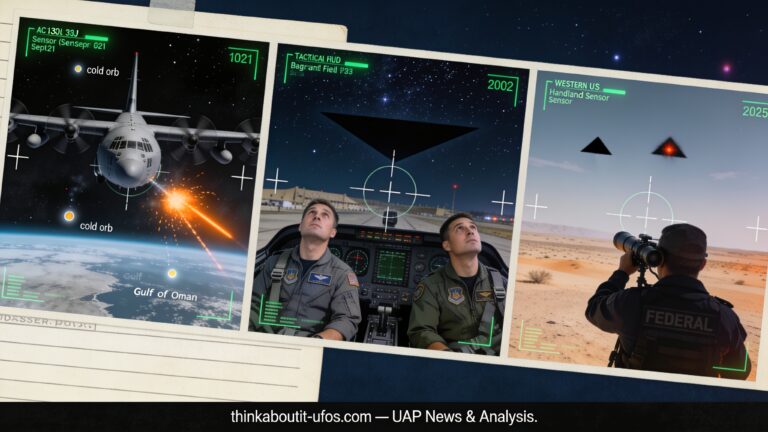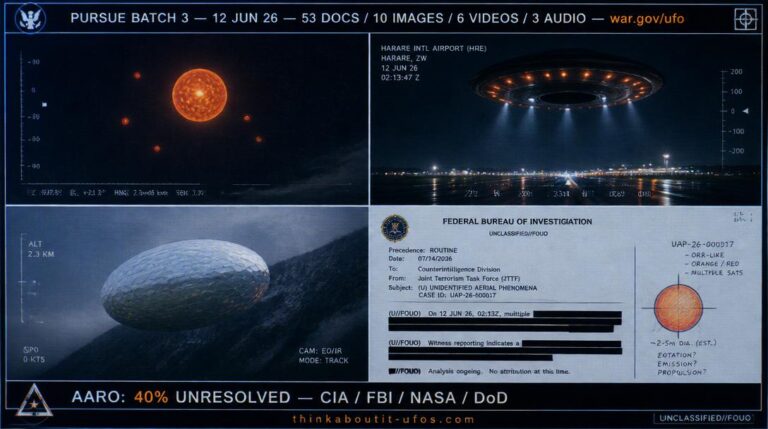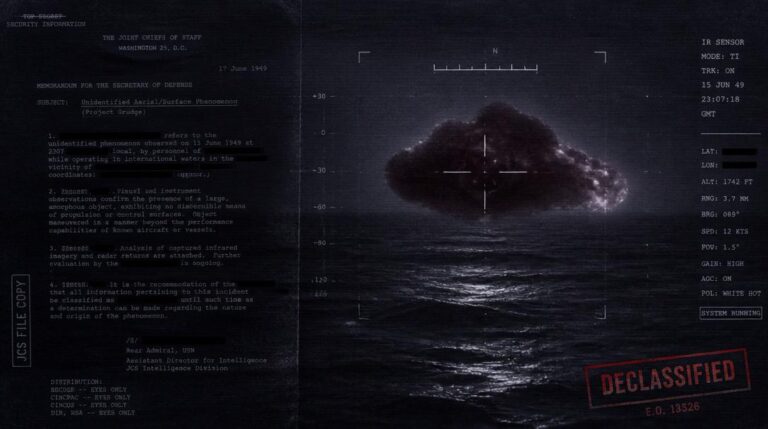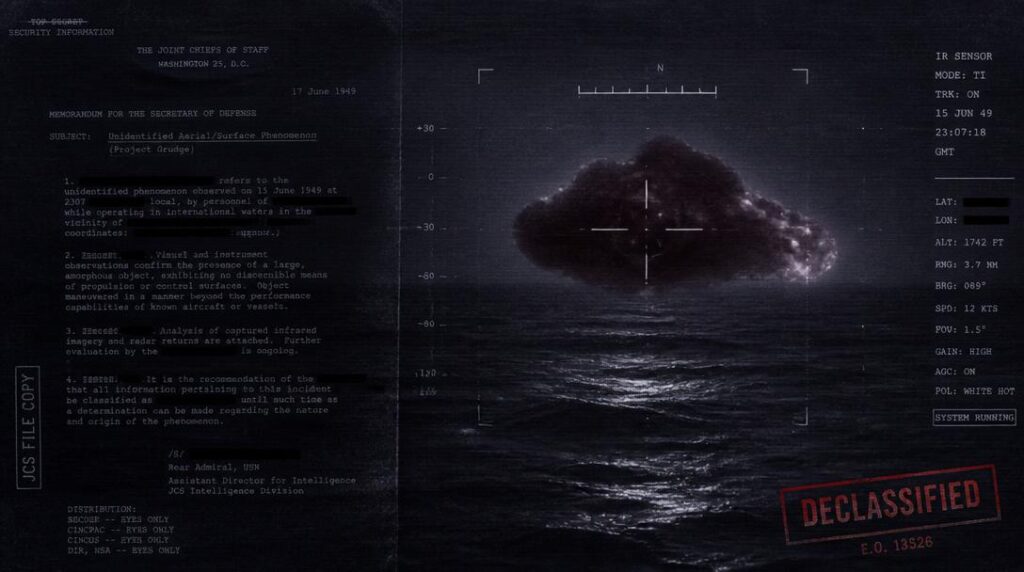
Archival composite referencing the July 10, 2026 PURSUE release, combining the 1949 Los Alamos green fireball transcript with 2020 Atlantic infrared footage.
The Pentagon just dropped its fourth batch of declassified UAP files — and buried inside a stack of 1940s Cold War transcripts and 2025 footage from the Yellow Sea is a detail that’s been floating around disclosure circles for years: a “floating brain” UAP, finally on video.
On Friday, July 10, 2026, the Department of War released the fourth tranche of files under the Presidential Unsealing and Reporting System for UAP Encounters (PURSUE) — the disclosure initiative launched under President Trump’s declassification order earlier this year. This release is smaller than the previous three: 40 files total, made up of 14 documents, 19 videos, four audio recordings, and three images, sourced from the Pentagon, NASA, the CIA, the FBI, and the Department of Energy. Pentagon spokesperson Sean Parnell confirmed more releases are already in the pipeline.
THE DETAILS
Historical Records
The centerpiece of the historical material is a transcript from a 1949 Atomic Energy Commission conference held at Los Alamos, where a group of the era’s top physicists — including Edward Teller and Manhattan Project veterans — gathered to try to explain a wave of “green fireball” sightings near the lab. Meteor specialist Dr. Lincoln LaPaz, who’d personally witnessed one of the events, told the assembled group the object was “most certainly not a conventional meteorite fall,” describing a fireball that appeared at full brightness instantly and traveled on a near-horizontal path — inconsistent with typical meteor behavior. BroBible
The release also includes a 1948 Project Sign document compiling 100 sighting reports from 1947–48 — the earliest formal government effort to track the phenomenon, launched in the wake of WWII-era “foo fighter” reports and the civilian sighting wave that followed, including the 1947 Roswell incident.
Recent Encounters
The most recent material in this batch comes from 2025, tracked under Indo-Pacific Command near China. One video shows a military sensor tracking what’s described as “an area of contrast resembling a six-pointed star” over the Yellow Sea; a second clip tracks an object over the East China Sea for several minutes.
Perhaps the most talked-about file is 32 seconds of 2020 infrared footage from over the Atlantic Ocean, showing a dark, maroon-hued, jellyfish-like object roughly 12–15 feet tall — drifting with the wind, balloon-like, with no sign of autonomous propulsion. It’s a strong match for what researchers have informally called the “floating brain” UAP, a shape that’s circulated in disclosure discussions for some time without confirmed footage attached to it.
RESEARCHER’S NOTES
Two things stand out here. First, the “green fireball” material isn’t new to ufology — Los Alamos green fireballs have been a fixture of early Cold War UFO history for decades — but an unredacted transcript with named physicists on record calling the phenomenon inconsistent with known meteor physics is a meaningfully stronger primary source than the secondhand accounts that have circulated until now.
Second, the shift toward Indo-Pacific/China-adjacent tracking data continues a pattern from earlier PURSUE releases: the most recent-vintage material tends to cluster around sensitive geopolitical theaters and military installations rather than random civilian sightings. Worth watching whether Release 5 continues that trend.
This is the fourth release since the program’s May 8, 2026 launch, and Pentagon officials say it won’t be the last. All files are publicly viewable, no login required, at war.gov/UFO.
About the Author