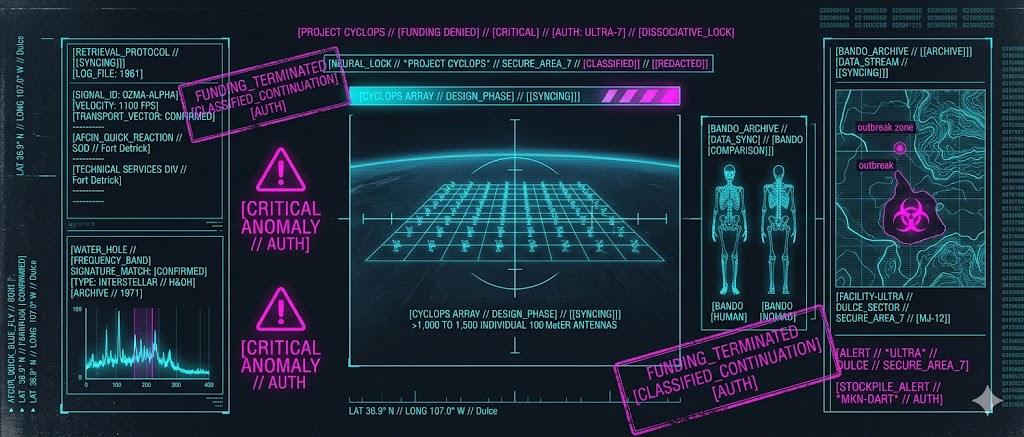
A tactical HUD showing a massive phased array of radio telescopes and signal frequency data for Project Cyclops.
THINK ABOUTIT SUMMARY:
Project Cyclops: The Massive Search for Interstellar Signals
Project/Group Name: Project Cyclops
Mission: To design a coordinated system of radio telescopes capable of detecting “leakage” or intentional radio signals from intelligent civilizations up to 1,000 light-years away.
Date Started: January 1971 (Feasibility Study). Ended: 1973 (Funding denied by Congress).
Who or Whom Started It: Dr. Bernard Oliver (Hewlett-Packard) and Dr. John Billingham (NASA).
Part of what Government Agency: NASA Ames Research Center / Stanford University.
Location: Proposed for the High Desert regions of the Southwestern United States.
Special Features/Characteristics:
-
Phased Array: A proposed orchard of 1,000 to 1,500 100-meter radio telescopes linked by computer to act as a single, massive antenna.
-
The Water Hole: Focused on the frequency band between the 1,420 MHz hydrogen line and the 1,662 MHz hydroxyl line (H and OH), where space is quietest.
Summary/Description: Project Cyclops was a landmark engineering study that detailed how humanity could realistically build a detection system for non-terrestrial signals. The proposed array would have covered an area nearly 10 kilometers in diameter. While it was never built due to its massive cost (estimated at $10 billion in 1970s currency), the Cyclops Report became the “bible” for all subsequent SETI initiatives and signal processing algorithms.
Related to: Project OZMA, The Jason Society, Project Phoenix, and The Wow! Signal.
Source: Project Cyclops: A Design Study of a System for Detecting Extraterrestrial Intelligent Life (NASA CR-114445).
Other Details: Skeptics and insiders suggest that the technology designed for Cyclops was privately funded and implemented under classified designations to monitor for NHI presence closer to the orbital “Grid” rather than deep space.
“The Cyclops Report became the blueprint for every ear humanity has since turned toward the stars.”
About the Author