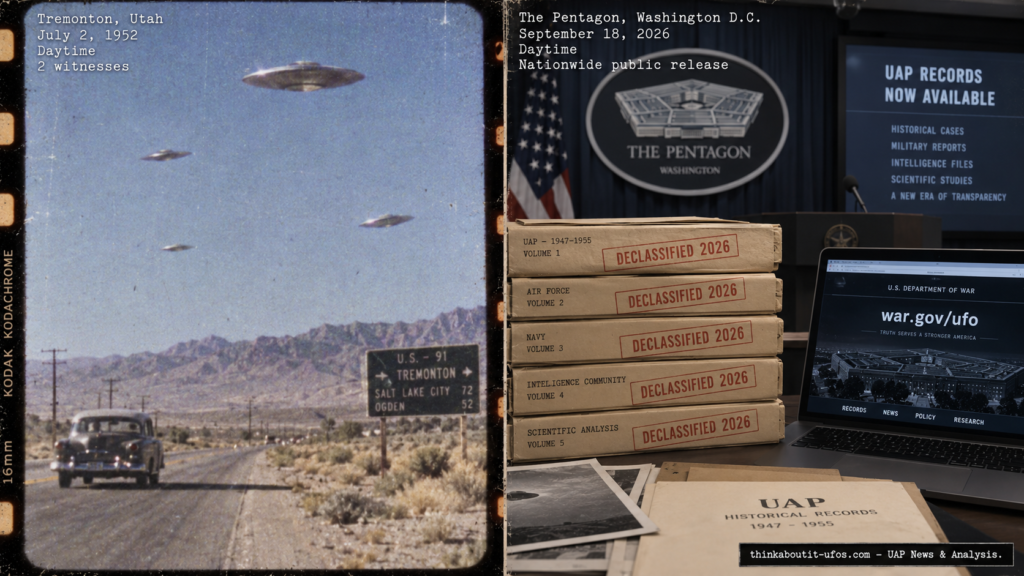
The Department of War's sixth PURSUE release, September 18, 2026, includes the original Tremonton, Utah UFO film and internal review documents
Pentagon Releases Sixth Batch of Declassified UAP Files
And This Time, the 1952 Tremonton “Solved” Story Comes Apart
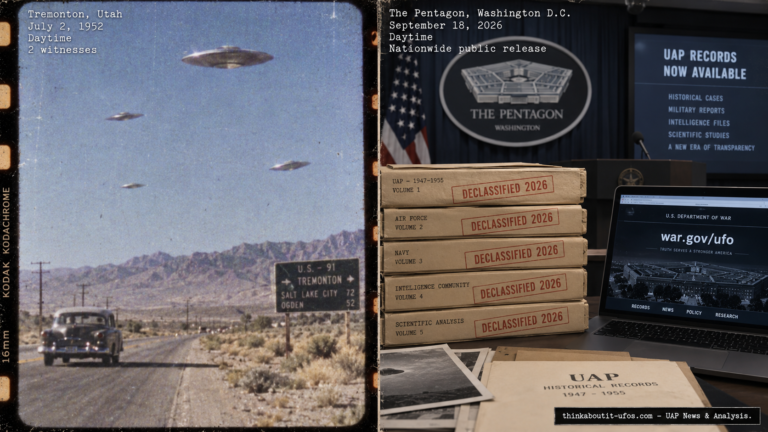
The Department of War published its sixth batch of declassified Unidentified Anomalous Phenomena files on Friday, September 18, 2026 — and buried inside a routine-sounding transparency drop is a genuinely newsworthy admission: the internal 1952 investigation into one of the most famous UFO films in American history was far more divided than the public was ever told.
What Was Released
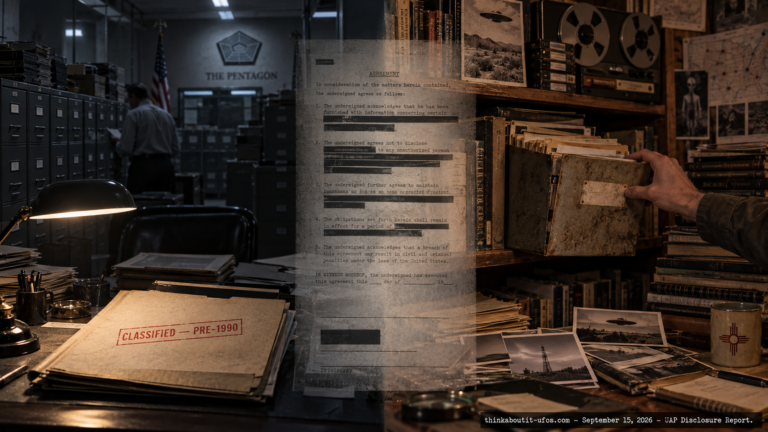
Friday’s release adds 10 new files to the Presidential Unsealing and Reporting System for UAP Encounters (PURSUE), the declassification portal the Department of War stood up in May 2026 under the Trump administration’s UAP transparency directive. Chief Pentagon spokesman Sean Parnell confirmed the files are now permanently housed at war.gov/ufo, with “additional files on a rolling basis” still to come.
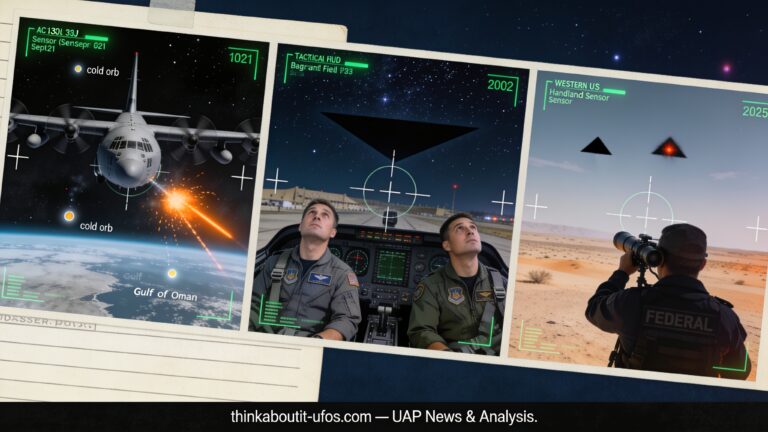
The headline item is the original 16mm Kodachrome footage shot by Navy Chief Warrant Officer Delbert C. Newhouse near Tremonton, Utah on July 2, 1952 — one of the most scrutinized pieces of UFO film evidence ever produced, now public in its original digitized form for the first time. Alongside it, the Department released the underlying Project Blue Book review documents, a 1952 presentation by Blue Book chief Capt. Edward J. Ruppelt, Defense Intelligence Agency material tied to the 2008 Advanced Aerospace Weapon System Applications Program (AAWSAP) — including a 2010 report on spintronics, a computing and sensor technology using electron spin — and two 2023 cellphone videos submitted by a Colorado law enforcement officer depicting a silent object cycling through red, blue and green lights.
The Pentagon’s All-domain Anomaly Resolution Office (AARO) added a notable caveat on the Colorado footage: cellphone autofocus and digital processing, AARO cautioned, can distort the apparent shape and movement of distant objects — a rare instance of the Department flagging its own released evidence for a known limitation rather than letting it speak for itself.
Tremonton: The Real Story Behind the Footage
Newhouse and his family were on vacation, driving roughly seven miles north of Tremonton, when his wife spotted a loose cluster of bright objects against a clear, cloudless sky. Newhouse — a trained Navy photographer — pulled the car over, retrieved a Bell & Howell Auto Master camera fitted with a 3-inch telephoto lens from the luggage compartment, and filmed what he described as 10 to 12 objects “milling about in a rough formation” while generally heading west. Near the end of the sighting, one object broke away from the group; Newhouse held the camera steady and let it cross the frame repeatedly.
Newhouse himself was candid about the footage’s central weakness: with no clouds, buildings, terrain, or other fixed points in frame, he had no reliable way to judge the objects’ true size, distance, altitude, or speed. That gap has haunted every analysis of the film for 74 years.
In December 1952, a formal review panel — Project Blue Book personnel, professional balloon specialists, and representatives from General Mills, then a major manufacturer of high-altitude research balloons — examined the footage. The Department of War’s own newly released file quotes the panel’s stated consensus directly: the objects “closely resembled pillow balloons in flight and behaved consistently with that explanation.”
That’s the story that has circulated publicly for seven decades. What the new release adds is the dissent buried inside that same panel: one General Mills representative — a balloon specialist, with direct technical authority on the subject — pushed back, noting the objects appeared too bright and maneuvered too rapidly to be balloons. Additional internal notes in the file go further, describing the filmed objects as brighter than birds and not spherical in profile — observations that sit awkwardly next to a confident “it was balloons” verdict.
Tellingly, the Department of War’s own public-facing language on the release doesn’t claim the case is solved. Officials said the footage’s “limited detail and lack of fixed reference points prevented a conclusive determination” — a materially softer position than the balloon explanation that has defined the case’s popular reputation ever since 1952.
Ruppelt’s own 1952 presentation, released in the same batch, adds useful context: he told his audience that roughly 20% of the approximately 800 cases the Air Force had reviewed to that point remained unexplained after analysis — while explicitly stressing that the Air Force had drawn no conclusion about the underlying nature of the phenomenon itself. Even the man running the government’s UFO investigation wasn’t willing to call the broader subject closed, in the same year his own panel was quietly split over this specific film.
Why This Release Matters
Six batches into this disclosure effort, a pattern is becoming clear: the most significant revelations aren’t new sightings, but new visibility into how thoroughly — and how uncertainly — the government’s own analysts handled the old ones. Tremonton was never actually a closed case at the technical level; it was closed at the public-relations level, with a tidy one-line explanation standing in for a genuinely split internal review. That’s a materially different thing, and it’s the kind of distinction only the primary documents themselves can establish.
It’s also a useful reminder for anyone following this disclosure process: a “solved” case from the classic Blue Book era is only as solid as the paperwork behind it — and that paperwork is now, for the first time, actually available to check.
“One General Mills representative was less convinced, noting that the objects appeared somewhat too bright and seemed to maneuver too rapidly.”
— Department of War, PURSUE 6th batch release, September 18, 2026
About the Author