The Robertson Panel
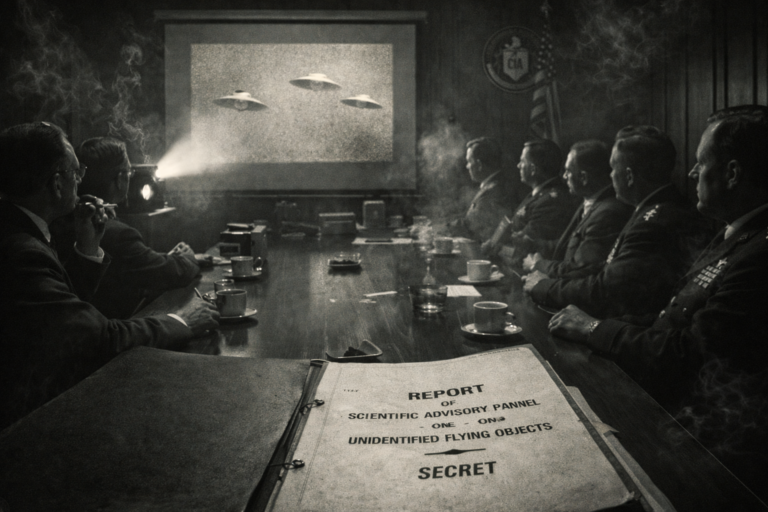
The Robertson Panel was a committee commissioned by the Central Intelligence Agency in 1952 in responses to widespread Unidentified Flying Object reports, especially in the Washington DC area. The panel was briefed on U.S. military activities and intelligence, hence the report was originally classified Secret.
Later declassified, the Robertson Panel’s report concluded that most UFO reports could be explained as misidentification of mundane aerial objects, and the remaining minority could, in all likelihood, be similarly explained with further study.
The Robertson Panel concluded that a public relations campaign should be undertaken in order to “debunk” UFOs, and reduce public interest in the subject, and that civil UFO groups should be monitored. There is evidence this was carried out more than two decades after the Panel’s conclusion.
Critics (including a few panel members) would later lament the Robertson Panel’s role in making UFO’s a somewhat disreputable field of study.
History
In 1952, so many civilians contacted various government agencies regarding UFO reports that daily governmental duties were impacted; the New York Times reported on August 1, 1952 that the many UFO reports had “regular intelligence work has been affected.” Various newspapers, such as the Baltimore Sun, Washington Star, Denver Post, and Los Angeles Times, reported on July 31 that Air Force Chief of Staff Hoyt S. Vandenberg’s views that the recent spate of UFO sightings and reports had generated “mass hysteria”. [1] There was a general concern among the military that the hysteria and confusion generated by UFO reports could be utilized by the United States’ enemies, primarily the Soviet Union.
The Air Force had earlier commissioned the Battelle Memorial Institute to scientifically study the various UFO reports collected by Project Sign, Project Grudge and Project Blue Book, but Battelle insisted they needed more time to conduct a proper study. The CIA thought the question so pressing that they authorized an ad hoc committee in late 1952.
The ‘’’Robertson Panel’’ first met formally on January 14, 1953 under the direction of Howard Percy Robertson. He was a physicist, a CIA employee and director of the Defense Department Weapons Evaluation Group.
Other panel members were respected scientists and military personnel who had worked on other classified military projects or studies. All were then skeptical of UFO reports, though to varying degrees:
Louis Alvarez, physicist (and later, a Nobel Prize winner)
Frederick C. Durant, missile expert
Samuel A. Goudsmit, Brookhaven National Laboratories physicist
Thornton Page, astrophysicist, deputy director of Johns Hopkins’ Operations Research Office.
Lloyd Berkner, physicist and J. Allen Hynek, astronomer, were associate panel members.
Formal Meetings
The Panel had four consecutive days of formal meetings.
The first day, they viewed two amateur motion pictures of UFO’s: the 1950 Montana UFO Film and 1952 Utah UFO Film (the latter was taken by Navy Chief Petty Officer Delbert C. Newhouse, who had extensive experience with aerial photography). Two Navy photograph and film analysts (Lieutenants R.S. Neasham and Harry Woo) then reported their conclusions: the two films depicted objects that were not any known aircraft, creature or weather phenomena. Air Force Captain Edward J. Ruppelt then began a summary of Air Force efforts regarding UFO studies.
The second day, Ruppelt finished his presentation. Hynek then discussed the Battelle study, and the panel discussed with Air Force personnel the problems inherent in monitoring UFO sightings. (For more on the results of the Battelle study, see Project Blue Book)
The third day, Dewey J. Fournet spoke to the panel; for over a year he had coordinated UFO affairs for The Pentagon. Fournett supported the extraterrestrial hypothesis as the best explanation for some puzzling UFO reports. For the remainder of the third day, the panel discussed their conclusions, and Robertson agreed to draft a preliminary report.
The fourth and final day, the panel rewrote and finalized their report.
The Robertson Panel’s official report concluded that 90 percent of UFO sightings could be readily identified with meteorological, astronomical, or natural phenomena, and that the remaining 10 percent of UFO reports could, in all likelyhood, be similarly explained with detailed study. It was suggested that witnesses had misidentified bright stars and planets, meteors, auroras, mirages, atmospheric temperature inversions, and lenticular clouds; other sightings were judged as likely misinterpretation of conventional aircraft, weather balloons, birds, searchlights, kites, and other phenomena.
Furthermore, the Panel suggested the Air Force should begin a “debunking” effort to reduce “public gullibility” and demystify UFO reports. The panel suggested a public relations campaign, using psychiatrists, astronomers and assorted celebrities to significantly reduce public interest in UFO’s. It was also recommended that the mass media be used for the debunking, including influential media giants like Walt Disney Corporation.
Their formal recommendation stated “That the national security agencies take immediate steps to strip the Unidentified Flying Objects of the special status they have been given and the aura of mystery they have unfortunately acquired.”[2]
Also recommended was that the government monitor civilian groups studying or researching UFO’s “because of their potentially great influence on mass thinking … the apparent irresponsibility and possible use of such groups for subversive purposes should be kept in mind.’
The Robertson Panel’s conclusions and recommendations had a great influence on official United States policy regarding UFO’s for many decades.
The Robertson Panel’s study was classified for five years. In 1956, however, Ruppelt made the first public statements regarding the panel, when he offered a brief summary of its proceedings. Ruppelt did not, however, note the panel members’ names, nor the government agencies represented.
source and references:
Jerome Clark, The UFO Book: Encyclopedia of the Extraterrestrial, ISBN 1578590299
Jenny Randles and Peter Houghe; The Complete Book of UFOs: An Investigation into Alien Contact and Encounters;
Sterling Publishing Co, Inc, 1994; ISBN 0806981326
Edward J. Ruppelt, The Report on Unidentified Flying Objects, 1956, Chapter 18 online
Terry Hansen, The Missing Times: News media complicity in the UFO cover-up, 2000, ISBN 0-7388-3612-5
About the Author