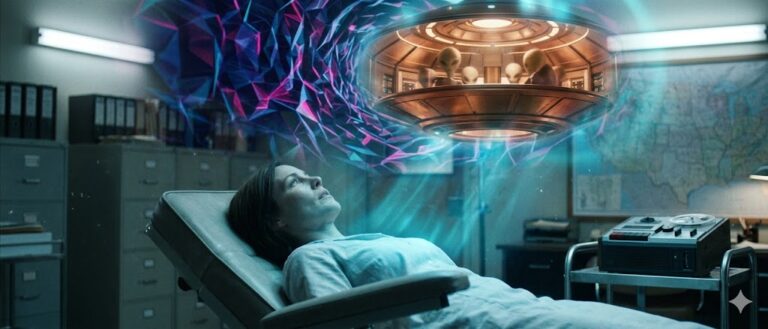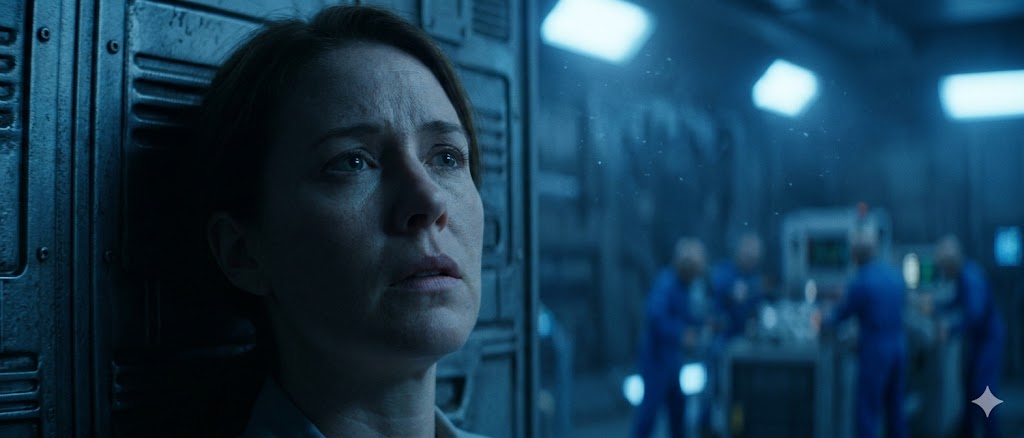
A visualization of Bonnie Jean Hamilton's "blue robot" encounter, emphasizing the oppressive blue atmosphere and the clinical inefficiency she described.
The case of Bonnie Jean Hamilton offers a harrowing glimpse into the mechanical and often clinical nature of the alien abduction phenomenon. In October 1988, Hamilton encountered “blue robots”—sentient beings whose movements were eerily repetitive and robotic, suggesting they were low-level drones operating under the command of a higher intelligence.
This encounter transcends the typical “Gray alien” narrative, focusing instead on the bizarre industrial aesthetic of the craft and the unsettling efficiency of the beings within. Hamilton’s testimony provides a rare description of “information gathering” areas and specialized medical indentations used during onboard procedures, painting a picture of a highly organized, non-human logistical operation.
The Abduction of Bonnie Jean Hamilton
In October of 1988, I had an experience with some creatures I called “blue robots.” They were living, sentient beings, wearing blue overalls even, but their movements were robotic in nature, and I was under the impression they were acting under orders, doing what they had been told by someone else. I went along with what they wished, knowing what was expected of me without the use of speech. I had total freedom of movement.
I was inside a circular metal room, about 20 feet in diameter, aboard what seemed to be a spaceship. I stood still and watched while the little blue robots swarmed all around me, only as tall as my waist. There were approximately six beings in my immediate vicinity and others running errands in other parts of the room. They were communicating with one another and very busily running back and forth, doing their work, which somehow involved me.
I knew they wanted to “operate” on me, and even though I couldn’t be sure, I assumed it would be an easy, outpatient type of procedure. I had picked up this bit of information by listening and observing. I remained calm and patient, more curious than afraid.
I had been standing in what was an information area – there were no seats or operating tables in this section of the room, so when they were finished with that “information gathering” part of their work, they escorted me to a place on the opposite side of the room. There was a circular indentation in the floor, about 6 inches deep.
They asked me to step down into it and stand there. Two of them helped me step down and turn so I was facing a wall. I had free movement of my body; they were just leading me. I asked them why I needed an operation and the response was that I had “pain” and they needed to fix it (this is a typical response that I have heard over and over again, and it is obviously not the whole truth).
I was staring at what looked to me like the back of a television set, which they had asked me to “keep my eyes on.” At that point, things became confusing to me; my head became dizzy and my vision was out of focus. What I saw was a tool that was drilling into the back of the supposed television set. There was a loud BANG and a flash of light, and the operation was over.
I then realized that the hole being drilled was not into the back of a television set, but into the back of my head! Within the week, I had developed a lump in the same location on the back of my head. I went to a local doctor (a general practitioner) who said I had a cyst that could be removed with surgery, or I could just let it sit there and, if it bothered me, he could prescribe pain medication.
I let the cyst sit there for about 15 years–in 2003, I had a doctor remove it. It appeared to be a mass of fatty tissue.
 Bonnie Jean Hamilton
Bonnie currently helps other contactees and abductees deal with their experiences. If you need help, contact her via E-mail at: bonniejeanhamilton@hotmail.com
Source & References:
Copyright © Bonnie Jean Hamilton 2006
Used by Permission
Executive Summary
During her abduction, Bonnie Jean Hamilton was escorted into a circular metal room where she observed a swarm of small, waist-tall beings in blue overalls. These “robots” communicated silently and moved with a sense of urgent “work” that centered around Hamilton herself. The procedure involved a specialized “information gathering” phase before she was moved to a circular indentation in the floor and instructed to face a wall, losing sensory focus as a drilling tool was applied to her head.
The physical aftermath of the event was marked by a persistent lump on the back of her head, which a general practitioner initially dismissed as a common cyst. After carrying the object for 15 years, Hamilton had it surgically removed in 2003, where it was described as a mass of fatty tissue. Today, Bonnie Jean Hamilton utilizes her experience to counsel other contactees, helping them navigate the psychological and physical trauma of NHI encounters.
“I asked them why I needed an operation and the response was that I had ‘pain’ and they needed to fix it—a typical response that is obviously not the whole truth.”
About the Author