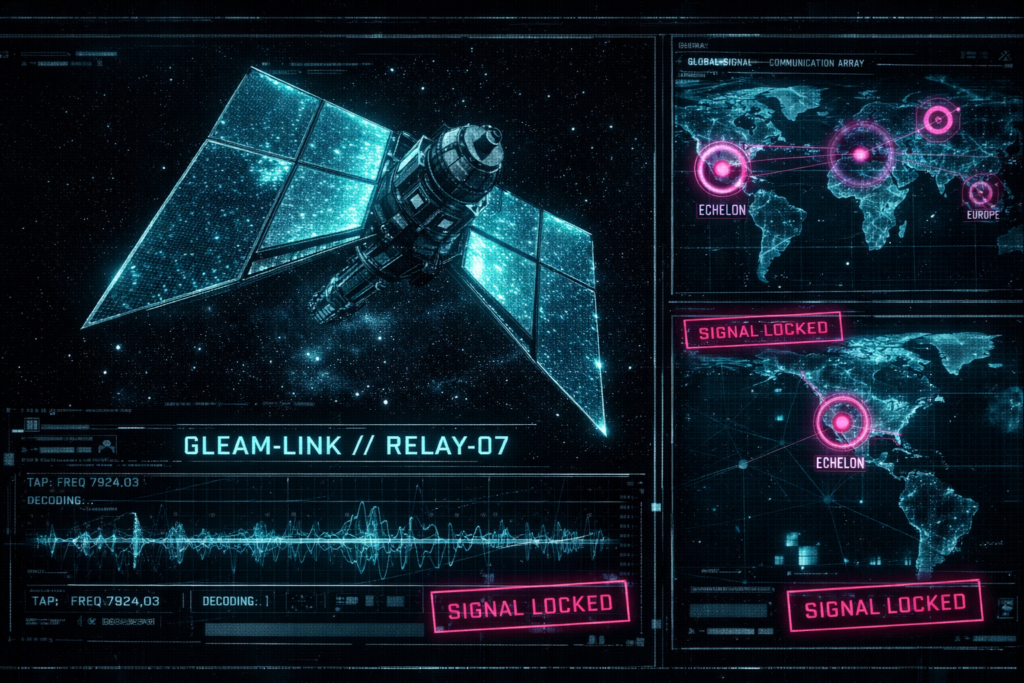
A visualization of the Project Gleam satellite infrastructure used for communication with NHI visitors.
THINK ABOUTIT SUMMARY:
Project Gleam: The NSA’s Alien Communication Satellite Network
Project/Group Name: Project Gleam
Mission: To facilitate direct, real-time communication with Non-Human Intelligence (NHI) via a global network of specialized relay stations and satellites.
Date Started: Allegedly first tested in 2002. Ended: Active (Ongoing).
Who or Whom Started It: Joint collaboration between US Intelligence and “The Visitors.”
Part of what Government Agency: National Security Agency (NSA) / Department of Defense (DoD).
Location: Global relay hubs (utilizing the Echelon infrastructure); Command center believed to be located within the NSA’s Fort Meade or specialized remote installations.
Special Features/Characteristics:
- Visitor Technology: Incorporates alien-origin hardware to stabilize communication across vast distances or dimensions.
-
Echelon Integration: Hijacks or “piggybacks” on the existing Echelon global surveillance network to route data through terrestrial and orbital channels.
Summary/Description: Project Gleam is described as the contemporary successor to Projects Sigma and Plato. While older initiatives relied on localized landing meetings or primitive signals, Gleam utilizes a “complex, highly classified series of relay stations” to maintain a permanent digital or telepathic link with NHI craft and homeworlds. It represents the modernization of the “Ambassador” protocol, likely functioning as the primary data-uplink for the Serpo exchange.
Related to: Project Sigma, Project Plato, Echelon, and Project Serpo.
Source: Leaked Pentagon documents via Serpo.org (August 2006).
Other Details: Because Gleam is a relatively “new” name in the UFO lexicon (appearing in the mid-2000s), it is theorized to be the operational sub-project that handles the actual data encryption and signal processing for the broader diplomatic efforts.
“The communication system consists of a complex, highly classified series of relay stations and satellites… part of the technology would have been provided by the ‘visitors’.”
About the Author