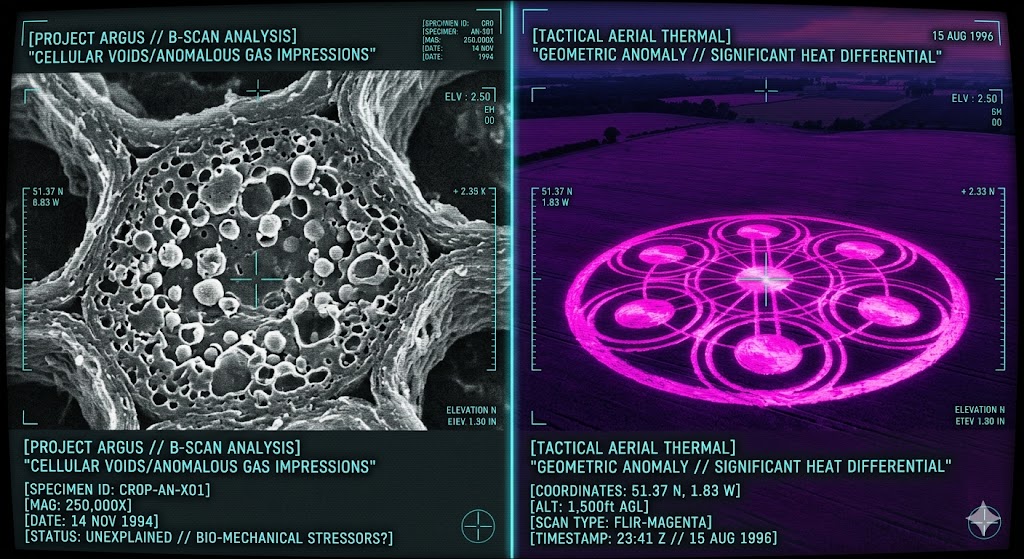
Microscopic view of plant cell anomalies next to a thermal scan of a crop circle.
THINK ABOUTIT SUMMARY:
Project Argus: Scientific Proof in the Fields?
Project/Group Name: Project Argus
Mission: To apply rigorous scientific and biophysical analysis to crop formations to determine if they are created by known kinetic forces (man-made) or unknown high-energy atmospheric phenomena (anomalous).
Date Started: Early 1990s (Formalized around 1992). Ended: Active through the late 1990s/early 2000s as a specialized research initiative.
Who or Whom Started It: Led primarily by biophysicist W.C. Levengood (of the Pinelandia Biophysical Laboratory) and the BLT Research Team (Nancy Talbott and John Burke).
Part of what Government Agency: Independent Scientific Initiative (though often linked in archive lore to covert monitoring of “anomalous energetic signatures”).
Location: Field samples taken globally (UK, USA, Canada); Laboratory analysis conducted in Michigan, USA.
Special Features/Characteristics:
- Expulsion Cavities: Discovery of “blown-out” nodes in plant stems, suggesting rapid internal heating.
-
Node Elongation: Statistically significant stretching of plant nodes within formations compared to control samples.
-
Crystalline Structure Changes: Alterations in the mineral composition of the soil and plant tissue.
Summary/Description: Project Argus represents the first major effort to move “cerealogy” into the lab. By using electron microscopy, researchers identified “micropores” or “bubbles” in the cell walls of affected plants. Levengood’s hypothesis was that the plants were subjected to a “Microwave Transient” or a spinning plasma vortex, which flash-heated the internal moisture of the plants, causing the cells to expand and the stems to bend without breaking—a feat nearly impossible to replicate with simple mechanical “planking.”
Related to: Project Aquarius (specifically environmental/biological monitoring), The BLT Research Team, and “Plasma Vortex” atmospheric theories.
Source: Physiologia Plantarum (Scientific Journal Publication by Levengood, 1994); BLT Research Team Archives; Laboratory Analysis Reports (Pinelandia).
Full Report
Analysis of thousands of samples suggests that the “bubbles” found in the cell walls are a result of rapid ion exchange and microwave-like heating. Furthermore, Argus researchers documented that seeds taken from these “anomalous” circles showed a significantly different growth rate (either accelerated or stunted) compared to normal seeds, indicating a fundamental genetic or energetic shift at the cellular level.
“The evidence suggests a high-energy atmospheric phenomenon… a force that changes the very genetic and cellular structure of the living organism.”
About the Author