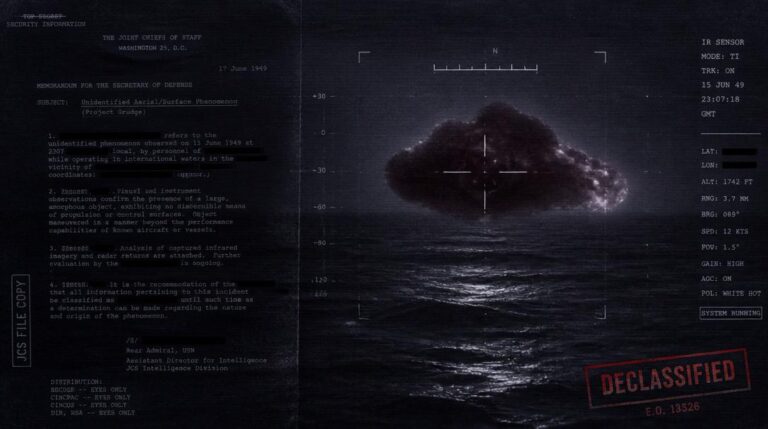
Gordon Cooper’s crew managed to film a metallic saucer landing, but the footage was immediately confiscated by the Pentagon.
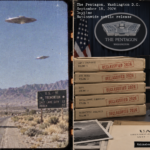
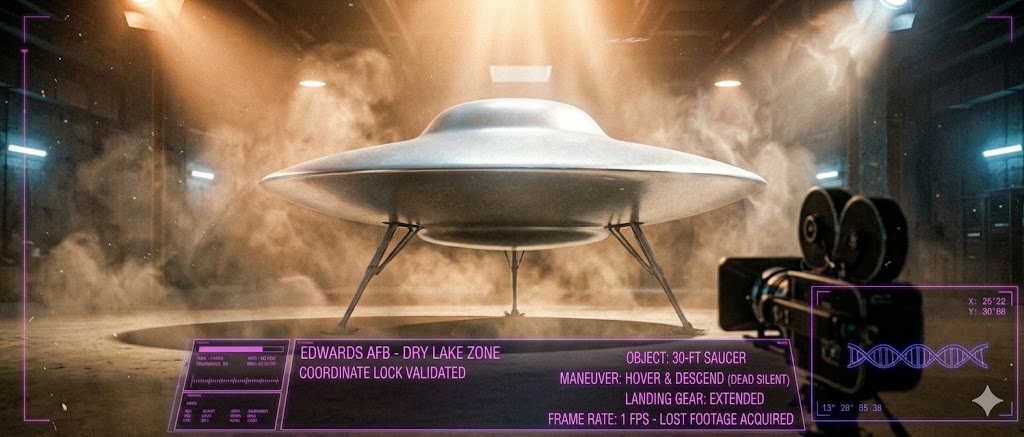
One of America’s original Mercury Seven astronauts, Gordon Cooper, went to his grave insisting that the U.S. government was concealing high-resolution footage of a craft not made on this Earth. In May 1957, while serving as a test pilot at Edwards Air Force Base, Cooper’s film crew captured a classic metallic saucer as it extended landing gear and touched down on a dry lake bed.
Despite Cooper personally processing the request to fly the footage to Washington D.C., the film vanished into the classified archives of the Pentagon, never to be seen by the public again. This archive documents the testimony of a man whose credibility was beyond reproach, detailing a “dead silent” landing that proved, in his own words, that we are being visited by advanced extraterrestrial civilizations.
Astronaut Gordon Cooper Witnessed a UFO Landing in 1957
“I had a camera crew filming the installation when they spotted a saucer. They filmed it as it flew overhead, then hovered, extended three legs as landing gear, and slowly came down to land on a dry lake bed. It was a classic saucer, shiny silver and smooth, about 30 feet across. It was pretty clear it was an alien craft.”
The event Cooper describes happened in 1957. At that time, he was one of the best test pilots at the Edwards Air Force Base in California.
He also managed several other projects belonging to the Experimental Flight Test School at Edwards and his credibility has never been called into question.
On May 3 of that year, he had his crew of engineers setting up an advanced photographic system that took one frame per second pictures of aircraft landing.
The location of the system was a dry lake bed and the weather was clear. The engineers had begun work early in the morning and were equipped with both still and motion picture cameras, in order to provide additional footage.
A little over 10 a.m., crew members James Bittick and Jack Gettys returned to Cooper saying they had witnessed a “strange-looking, saucer-like” craft that was dead silent during both landing and take-off.
This aspect worried him, as there was no known, man-made aircraft capable of such a feat. He also knew and trusted his crew and they were all experienced cameramen and wouldn’t have been easily mistaken.
They would see experimental aircraft on a daily basis and were familiar with their landing procedures. However, Cooper recalled that this experience was out of the ordinary and had visibly shaken the men.
They explained how the saucer hovered over their position, then extended its landing gear and landed not 50 feet away from them. Luckily, they never forgot they had cameras on hand and shot multiple photos and video footage. Once the men tried to approach the UFO, it rapidly took off without making a sound.
Cooper decided to follow protocol and called a special Pentagon service to report the incident. He was instructed by a general to have the film developed and immediately send it via military courier.
The high-ranking official specifically asked Cooper not to make any prints of the film. He did not, however, say anything about looking at the photo negatives.
“He didn’t say anything about me not looking at the film. That’s what I did when it came back from the lab and it was all there just like the camera crew reported,” Cooper said.
The photos were of excellent quality, as one would have expected of a team specifically trained in aircraft photography. Unfortunately, Cooper never got a chance to see the film reel before it was sent to the Pentagon.
During the following weeks, he expected to be contacted as part of an investigation of the event. After all, an aircraft of unknown origins had landed in one of the United States’ most classified military base.
But it never happened, and, despite his best efforts, Cooper was unable to track down the photos.

His assumption was that the photographic evidence ended up being sequestered by Project Blue Book, the Air Force’s official UFO investigation at Wright-Patterson AFB. He was convinced that “Blue Book was strictly a cover-up anyway.”
Right up until his death, the former astronaut maintained his beliefs and claims. In his memoirs, he wrote about the other unexplained aircraft he had witnessed throughout his career and also mentioned the existence of hundreds of similar reports.
“I had a good friend at Roswell, a fellow officer. He had to be careful about what he said. But it sure wasn’t a weather balloon, like the Air Force cover story. He made it clear to me what crashed was a craft of alien origin, and members of the crew were recovered.”
But the U.S. government was actively involved in sweeping the evidence under the rug. When asked what he thought about this tendency, Cooper responded:
“It started in World War 2, when the government didn’t want people to know about UFO reports in case they panicked. They would have been fearful it was superior enemy technology that we had no defense against.
“Then it got worse in the Cold War for the same reason. So they told one untruth, they had to tell another to cover that one, then another, then another… it just snowballed.
“And right now I’m convinced a lot of very embarrassed government officials are sitting there in Washington trying to figure a way to bring the truth out. They know it’s got to come out one day, and I’m sure it will.”
We sure hope so.
By Locklip
Executive Summary
The incident occurred on May 3, 1957, during the installation of an advanced photographic tracking system. Cooper was managing a crew of engineers including James Bittick and Jack Gettys when the encounter took place.
Key Technical Details:
The Craft: Described as a classic saucer—shiny, silver, smooth, and approximately 30 feet across.
Flight Maneuvers: The object flew overhead, hovered, and then extended three legs as landing gear before slowly descending to the dry lake bed.
The Footage: The crew was using 35mm motion picture cameras and still cameras. They were able to get very close to the craft before it took off at a high rate of speed.
Military Protocol: Cooper ordered the film developed and then sent it through official channels to the Pentagon. He was later informed that the footage was “classified” and it was never returned to the base.
Cooper’s Stance: Throughout his later life at NASA and in his book Leap of Faith, Cooper advocated for government transparency regarding UAPs, citing this 1957 event as his primary catalyst.
“It was a classic saucer, shiny silver and smooth… It was pretty clear it was an alien craft.” — Gordon Cooper
About the Author