The 1803 Utsuro-bune incident is considered one of the earliest documented "crash-retrieval" stories in history.
According to Japanese folklore, extraterrestrials may have visited planet Earth as early as the 19th century. This particular tale, which reportedly occurred in 1803, continues to inspire UFO enthusiasts because it provides a detailed, technical description of a “vessel” that bears a striking resemblance to a modern-day flying saucer—though it was discovered floating in the Pacific Ocean.
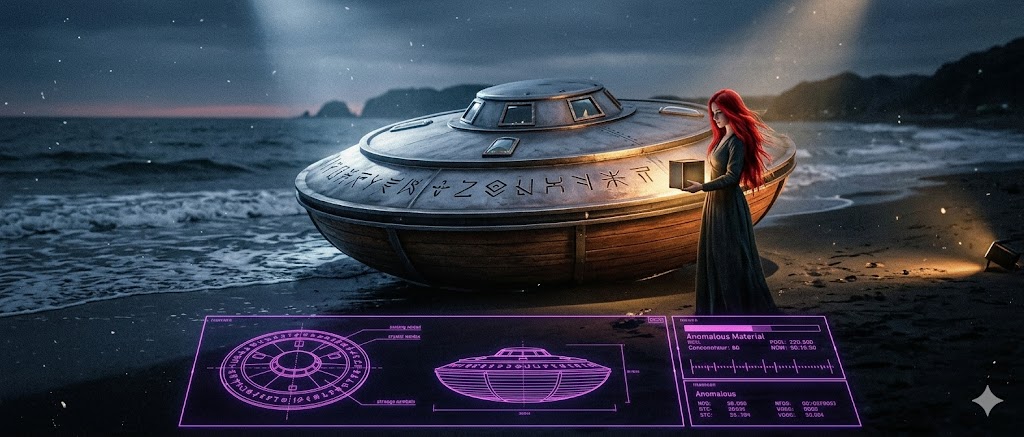
The story involves a group of Japanese sailors who discovered a strange, circular object with glass windows and a metallic lid. When the vessel was brought to shore, a beautiful woman with red hair emerged, clutching a mysterious box she would not allow anyone to touch. Because she spoke no known language and the materials of her clothing and ship were unrecognizable, the fearful villagers eventually pushed her back into the sea, leaving one of history’s most compelling pre-modern UAP encounters a mystery.
Mysterious Sailing Saucer And A Woman Identified In Japanese Folk Tale
According to Japanese folk tale, extraterrestrials visited planet Earth in the 19th century. Many stories and theories have been telling that aliens have been visiting Earth secretly for many centuries now. However, this particular folktale from Japan, which believed to happen in the early 1800s, continues to inspire many UFO enthusiasts and believers.
Reportedly written in 1825, the story starts with the discovery of a very unusual vessel floating in the ocean by Japanese sailors. Described by the sailors as a circular object, it appeared to have a lid covering the top of the ship with glass windows. When the very strange vessel got to shore, a gorgeous woman came out with bright red hair, holding an unknown box.
The woman would not allow anyone to touch it. Furthermore, the Japanese sailors can’t talk about it because the woman did not speak any known language. Also, unknown to them were the materials of the ship, clothes of a woman, and her box.
Because of fear, the villagers pushed the woman and her vessel into the sea again.
This story has been one of the most favorites among UFOlogists. The possibility of a flying saucer crashed in the sea that eventually washed up on land has given Ufologists the reason to believe the story.
Some speculates that aliens were attempting to blend in by matching technology on Earth, sending spacecraft when mankind could fly, and foreign vessels when all humans could do was sail. When skeptics argue, the UFO believers will point to the strange substances of the woman’s clothes and ship.
UFO believers claim that people during that time were not naïve or dumb not to recognize materials or vessels normally found on Earth. They believe that the foreign woman might have crashed or have been on a scouting ship.
The post Mysterious Sailing Saucer And A Woman Identified In Japanese Folk Tale appeared first on Latest UFO Sightings.
Executive Summary
The report analyzes the 1825 written account of the “Hollow Ship” (Utsuro-bune) discovered off the coast of Japan. Ufologists often cite this case as evidence that non-human intelligence (NHI) has been monitoring Earth for centuries, adapting their technology—from sailing saucers to flying disks—to match the human transportation of the era.
Key Investigative Elements:
-
The Anomalous Vessel: Described as a circular ship with a wooden lower half and a metallic upper lid, equipped with glass or crystal windows.
-
The “Red-Haired” Visitor: A woman of extraordinary beauty who possessed clothing made of unknown, soft fabrics and hair of a brilliant red color—a trait largely foreign to 19th-century Japan.
-
The Forbidden Box: The woman guarded a square box with extreme intensity, leading to theories that it may have contained flight logs, communication tech, or biological samples.
-
Technological Camouflage: Some theorists speculate that the saucer was designed to float rather than fly to “blend in” with the maritime technology of the 1800s.
“UFO believers claim that people during that time were not naïve or dumb not to recognize materials or vessels normally found on Earth.”
About the Author