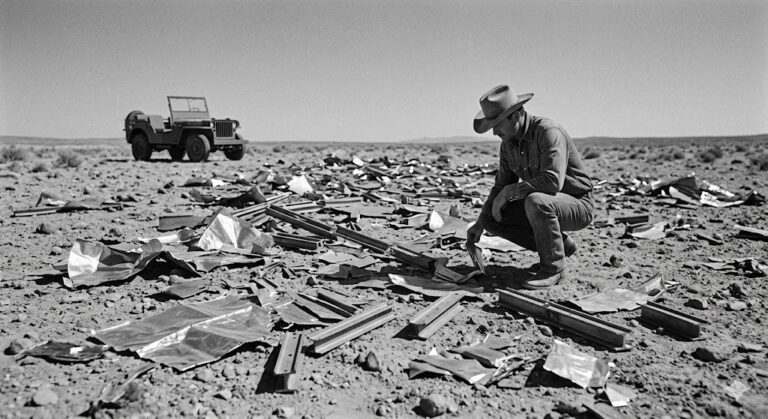
"Expeditious delivery to ATIC": A visual recreation of a Project Moon Dust recovery at Wright-Patterson AFB, 1961.
Project Moon Dust: The Secret Hunt for Fallen Soviet Tech and “Unidentified” Debris
On April 25, 1961, at the height of the Space Race, the Department of the Air Force issued a Confidential directive known as Intelligence Collection Guidance Letter No. 4. Its subject was MOON DUST, a specialized mission designed to locate, identify, and retrieve “foreign earth satellite vehicles” (ESVs) crashing back to Earth. While the public was focused on the glory of the first astronauts, the USAF Intelligence Directorate was quietly coordinating a global dragnet. This document provided field activities with precise instructions on how to report sightings of re-entering objects—described as brilliant clusters or “horizontal meteors”—and mandated the “expeditious delivery” of any recovered wreckage to the Aerospace Technical Intelligence Center (ATIC) at Wright-Patterson AFB.
For many UFO researchers, Project Moon Dust represents the missing link between conventional satellite tracking and the clandestine recovery of non-human technology. While the 1961 letter focuses on Soviet hardware, the broad terminology of “material deemed to be of air technical intelligence interest” left the door wide open for unconventional finds. The protocols were strict: verify location, ascertain identity, and “make every effort to obtain the object for the U.S.” This wasn’t just space archaeology; it was a high-stakes intelligence game played under a veil of Confidential alerts and rapid response teams.
Project Moon Dust: US Air Force Intelligence Guidance Collection Letter No. 4
|
|
CONFIDENTIAL 1452738 DEPARTMENT OF THE AIR FORCE AFCIN-1A 25 Apri1 1961 INTELLIGENCE COLLECTION SUBJECT: (U) MOON DUST Reporting TO: All Air Force Collection Activities 1. PURPOSE
This letter provides instructions and guidance for reporting information in response to MOON DUST Alerts. 2. APPLICABILITY
This letter is applicable world-wide for initiative reporting. 3. REFERENCE
Priority Air Intelligence Requirement (PAIR-1F). 4. BACKGROUND
Based on estimates of the time and place of foreign earth satellite vehicle (ESV) atmospheric re-entries, Headquarters USAF (AFCIN) initiates MOON DUST Alerts. They are issued as far in advance as practicable (normally 10 days) and are automatically cancelled three (3) days after the re-entry prediction date stated in the alert message. It is necessary that the alerts be issued on a world-wide basis until such time as techniques are developed that will make possible the prediction of the precise time and place of impact. 5. INSTRUCTIONS AND GUIDANCE During the periods when MOON DUST Alert is in effect, it is important that interested personnel receive, as rapidly as possible, accurate sighting data on the final (estimated) orbits from as many different sources as possible. The following guidance may assist in reporting observations of space vehicle re-entry. The re-entry of a space vehicle can be seen over great distances, and even the qualified observer cannot estimate the distance from point of observation to the sighted object with any great degree of certainty. At these distances, the re-entry would appear to resemble a meteor travelling in a near horizontal or descending path and, as the distance decreased, would appear as a brilliant object or cluster of objects visible during daylight conditions. In addition, an audible rumbling sound like thunder, arid possibly sharp explosion-like sounds might be correlated with the sighting.
(6) Apparent size of object as compared to the size of a coin or other familiar item held at arm’s length.
In the event a decayed space object is suspected as having descended, the following actions are required:
Reports in response to paragraph 5a. or b. above should cite the unclassified nickname MOON DUST and be addressed to the following:
6. CLASSIFICATION ASPECTS
Because of the intelligence connotations of MOON DUST regarding retrieval and examination by ATIC of a descended Soviet space vehicle, the overall project is classified Confidential, and MOON DUST Alerts are normally on a Confidential basis because of the intelligence association with decay estimates. The basic decay estimates (identification of the- object and estimated date and hour of decay) are in themselves normally unclassified. Thus, decay estimates, as such, can be released to observers or observatories cooperating with U.S. collectors purely on the basis of international cooperation in the scientific aspects of space knowledge. Reports of sightings transmitted by U.S. personnel should be classified according to source or content in accordance with normal reporting and transmitting procedures, and in the case of reports on visual sightings, will normally be unclassified. FOR THE CHIEF OF STAFF: /s/ Lowell E May CONFIDENTIAL National Archives and Records Administration December 2, 2003 Dear Mr. Klotz: I am forwarding to you one copy of “Intelligence Collection Guidance Letter No.4” from folder “Detachment #5” located in Box 1 of 1 for accession 65A3236. As stated in my email to you of this date, we will continue to search for the other accession you requested, 61A1357. Sincerely, /s/ Herbert Rawlings-Milton Enclosure
NARA’S web site is http://ww.archives.gov |
This post analyzes the declassified 1961 memorandum obtained through the efforts of CUFON and several dedicated archivists at NARA. The document details the ten specific data points required for a “Moon Dust Alert” report, including azimuth, elevation, duration of sighting, and any “unusual or other than normal sounds.” It reveals that while visual sightings by observers were often unclassified to encourage public cooperation, the “overall project” and the “decay estimates” remained classified Confidential due to their sensitivity. Destination agencies for these high-priority reports included the Space Track R & D Activity at Hanscom Field and the NORAD headquarters at Ent AFB, showing the multi-agency scope of the program.
The summary also addresses the debate surrounding Moon Dust’s true purpose. As Jim Klotz and Dale Goudie of CUFON noted upon receiving the document in 2003, while this letter highlights a focus on foreign satellites, it does not eliminate Moon Dust’s role in the “real secret” UFO projects. The requirement to recover material from anywhere in the world and ship it to the ATIC—the same facility that managed Project Blue Book—suggests that Moon Dust was the “vacuum cleaner” for any anomalous object that fell from the sky. This post serves as a primary source look at how the military organized the retrieval of the unknown during the dawn of the space age.