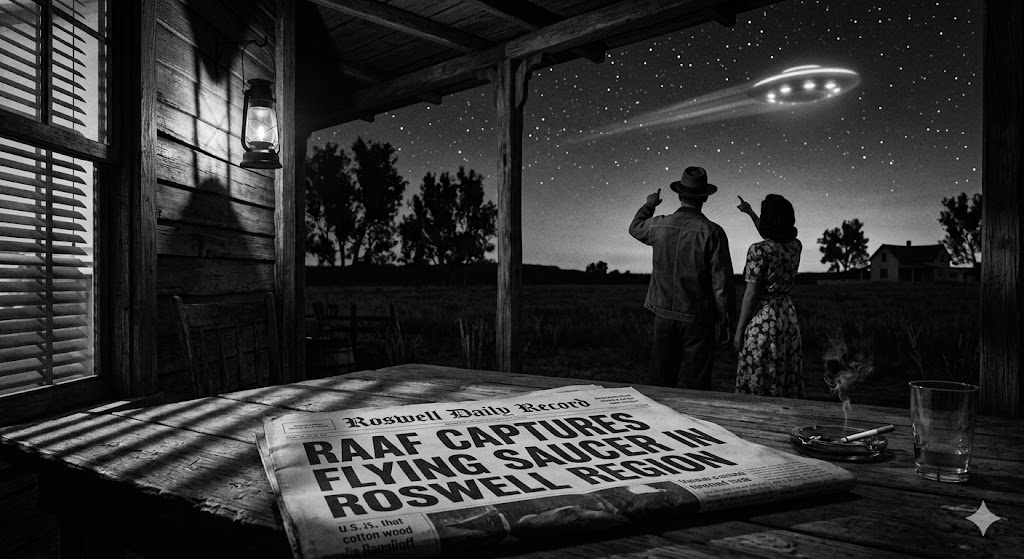
The headline that shook the world: The original July 8, 1947, report before the weather balloon retraction.
“RAAF Captures Flying Saucer”: The Headline That Changed Everything
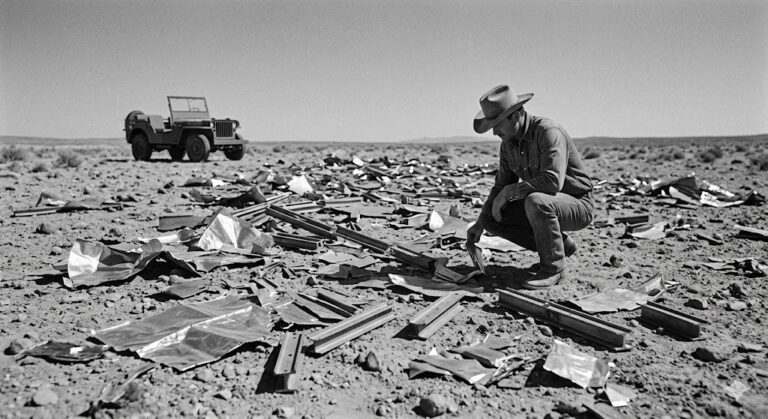
On July 8, 1947, the Roswell Daily Record published a front-page story that would become the most famous headline in the history of the paranormal. The article announced that the intelligence office of the 509th Bombardment Group had “come into possession of a flying saucer” recovered from a local ranch. For a brief, electrifying moment, the U.S. military appeared to have confirmed that extraterrestrial technology was real. The story detailed how Major Jesse A. Marcel had recovered the wreckage after a rancher, W.W. Brazel, reported finding strange debris consisting of “tinfoil, rubber strips, and parchment-like material with purplish symbols.”
However, the excitement was short-lived. By the next morning, July 9, the narrative had shifted completely. Under the headline “Gen. Ramey Empties Roswell Saucer,” the military retracted the previous day’s statement, claiming the “flying disc” was nothing more than a high-altitude weather balloon and a radar-reflector. This rapid pivot created a legacy of skepticism that lasts to this day, as researchers point to the detailed witness testimony of “hieroglyphic” symbols and “unbreakable” materials as evidence that the weather balloon story was a hastily manufactured cover-up.
This clipping is a famous article from the Roswell Daily Record, originally published on July 9, 1947. It tells the story of W. W. Brazel, the rancher who discovered the debris that sparked the Roswell UFO incident.
Harassed Rancher who Located ‘Saucer’ Sorry He Told About It
W. W. Brazel, the 48-year-old rancher who located the “flying saucer” on his property 75 miles north of Roswell, said today he was “sorry” he ever mentioned the find.
Brazel, who lives on a ranch without a telephone or radio, was initially unaware of the “flying disc” craze sweeping the country. He discovered the debris—consisting of rubber strips, tinfoil, a rather tough paper, and sticks—scattered over an area about 200 yards in diameter while checking his sheep following a severe thunderstorm.
Description of the Debris
According to Brazel, the material did not resemble any weather balloon he had previously found on the property. The wreckage included:
- Tinfoil and rubber
- Paper and sticks
- Parchment-like material with purplish symbols or hieroglyphs
Reporting the Find
After hearing rumors of “flying discs” during a trip to nearby Corona on July 5, Brazel began to wonder if his discovery was related. On July 7, he drove to Roswell and notified Sheriff George Wilcox, who in turn contacted Major Jesse A. Marcel, the intelligence officer of the 509th Bomb Group at Roswell Army Air Field.
Following the military’s involvement and the subsequent media frenzy, Brazel expressed regret over the publicity, stating he would not have reported it had he known the trouble it would cause. He noted that he was “harassed” by the sudden attention and just wanted to get back to his work on the ranch.

Gen. Ramey Empties Roswell Saucer
Ramey Says Disc is Only Weather Balloon; No Details of Construction Revealed
FORT WORTH, July 9 (AP) — Brigadier General Roger Ramey, commander of the Eighth Air Force, said today that a “flying disc” recovered by the Army Air Force near Roswell, New Mexico, was actually a weather balloon and its radar-target.
The general’s statement effectively “emptied” the saucer story that had captured international headlines only 24 hours earlier when the Roswell Army Air Field first announced it had a “flying disc” in its possession.
Examination at Higher Headquarters
After the intelligence office at Roswell had initially inspected the instrument, it was flown to General Ramey’s headquarters in Fort Worth for further examination. General Ramey stated that the object consisted of a high-altitude weather balloon and a kite-like radar reflector made of aluminum foil and balsa wood.
Major Jesse A. Marcel, the intelligence officer who originally recovered the debris from a ranch north of Roswell, was present during the examination. The Air Force now maintains that the debris was not a saucer but part of a then-classified project known as Project Mogul, designed to monitor Soviet nuclear tests.

RAAF Captures Flying Saucer On Ranch in Roswell Region
No Details of Flying Disk Are Revealed
Roswell Hardware Man and Wife Report Disk Seen
The intelligence office of the 509th Bombardment group at Roswell Army Air Field announced at noon today, that the field has come into possession of a flying saucer.
According to information released by the department, over authority of Maj. J. A. Marcel, intelligence officer, the disk was recovered on a ranch in the Roswell vicinity, after an unidentified rancher had notified Sheriff Geo. Wilcox, here, that he had found the instrument on his premises.
Major Marcel and a detail from his department went to the ranch and recovered the disk, it was stated.
After the intelligence office here had inspected the instrument it was flown to “higher headquarters.”
The intelligence office stated that no details of the saucer’s construction or its appearance had been revealed.
Mr. and Mrs. Dan Wilmot apparently were the only persons in Roswell who have seen what they thought was a flying disk.
They were sitting on their porch at 105 South Penn. last Wednesday night at about ten minutes before ten o’clock when a large glowing object zoomed out of the sky from the southeast, going in a northwesterly direction at a high rate of speed.
Wilmot called Mrs. Wilmot’s attention to it and both ran down into the yard to watch. It was in sight less then a minute, perhaps 40 or 50 seconds, Wilmot estimated.
Wilmot said that it appeared to him to be about 1,500 feet high and going fast. He estimated between 400 and 500 miles per hour.
In appearance it looked oval in shape like two inverted saucers, faced mouth to mouth, or like two old type washbowls placed together in the same fashion. The entire body glowed as though light were showing through from inside, though not like it would be if a light were merely underneath.
From where he stood Wilmot said that the object looked to be about 5 feet in size, and making allowance for the distance it was from town he figured that it must have been 15 or 20 feet in diameter, though this was just a guess.
Wilmot said that he heard no sound but that Mrs. Wilmot said she heard a swishing sound for a very short time.
The object came into view from the southeast and disappeared over the treetops in the general vicinity of six-mile hill.
Wilmot, who is one of the most respected and reliable citizens in town, kept the story to himself hoping that someone else would come out and tell about having seen one, but finally today decided that he would go ahead and tell about seeing it. The announcement that the RAAF was in possession of one came only a few minutes after he decided to release the details of what he had seen.
This post breaks down the three key narratives found in the July 1947 clippings. First, it follows the story of W.W. Brazel, the “harassed” rancher who initially ignored the “flying disc” craze until he visited nearby Corona. Brazel’s regret over reporting the find highlights the intense military and media pressure that immediately surrounded the event. The transcript details his specific description of the debris—materials that didn’t look like any weather balloon he’d ever seen—and the “swishing” sounds reported by local citizens like Mr. and Mrs. Dan Wilmot, who saw a glowing, oval-shaped object zoom over Roswell just days before the crash.
The second half of the post focuses on the military’s involvement, specifically the roles of Major Jesse A. Marcel and Brigadier General Roger Ramey. It highlights the physical journey of the debris from Roswell Army Air Field to the Eighth Air Force headquarters in Fort Worth, where the official “weather balloon” debunking took place. By contrasting the eyewitness accounts of highly reliable citizens with the official military retraction, the post illustrates the birth of the Roswell conspiracy and the enduring mystery of what was truly recovered in the New Mexico desert.