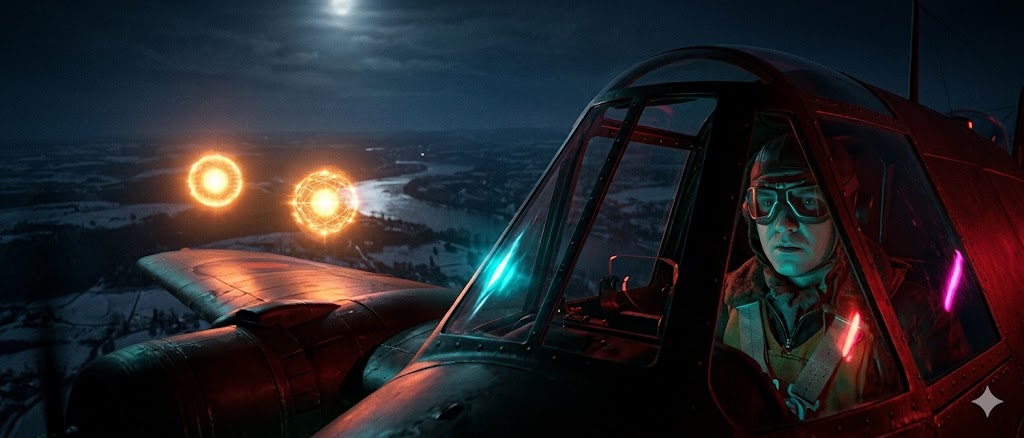
Allied pilots frequently reported "Foo-Fighters"—luminous orbs that demonstrated intelligent maneuvers and extreme speeds.
Before the 1947 Arnold sighting launched the “Flying Saucer” era, Allied pilots were already encountering high-strangeness in the skies over Europe and the Pacific. Known as “Foo-Fighters,” these luminous, intelligent orbs shadowed bomber formations and outmaneuvered the most advanced night fighters of the era. These declassified documents—sourced from the National Archives—provide the raw, internal military record of encounters that defied conventional physics during the height of World War II.
FOO-FIGHTER DOCUMENTS
| 09-September-1998 The text of several official documents mentioning Foo-Fighters and Foo-Fighter-like phenomena are presented here.
These documents were located, and provided to CUFON, by Barry Greenwood, veteran researcher, for many years the Editor of the widely celebrated bulletin Just Cause, co-author of the breakthrough Clear Intent, and now the Editor of the U.F.O. Historical Review which debuted in June, 1998. Barry can be reached by mail at: UHR, Box 176, Stoneham MA 02180, USA. The UHR is available by subscription at the above address at the rates of: (in the US) $15.00 per year, and $20.00 (US) per year outside of the USA. Each issue of the UHR will contain interesting items like the Foo-Fighter documents presented here, and insightful comment by Mr. Greenwood. Foo-Fighters are often mentioned in the UFO literature as being among the first modern era sightings of unidentified aerial objects, predating as they do the widely known civilian Arnold sighting of June, 1947. Seldom however, is documentary evidence of the reality and nature of these sightings presented to support mention of the Foo-Fighters. While the documents presented herein by no means represent all such material, they are a dramatic insight into the UFOs of the Second World War, and come from both the European and Pacific regions. Small portions of the document copies the text of which is presented here were illegible, usually part of a word, a single word, and in one case, most of one line of text. These illegible portions are noted with question marks ( ? ) Where security markings are crossed out or blacked out, this is indicated by square brackets [ ] Where handwritten material exists in the body of a document, that material is enclosed in ‘curly brackets’ { } Page breaks within a document or between pages of a collection of documents which belong together are also noted inside curly brackets’ { }
|
|
REPRODUCED AT THE NATIONAL ARCHIVES |
| UNIT REPORTING : 415TH NIGHT FIGHTER SQUADRON
MISSIONS : 3 MISSIONS 3 SORTIES DATE 13/14 FEBRUARY REPORT: |
|
1. Intruder Mission – 1800-1945 hours. East of Rhine between Freiburg & 2. Intruder Mission – 1700-2000 hours. Neustadt, Karlsruhe and Manheim. 3. 2245-2305 – Scramble. Nothing to report. Returned early due rough CLAIMS |
| TypeMotor Transport R/R Tank Car Supply Dump at HeidelburgLOSSESNone |
Destroyed 1 1 0 |
Damaged 15 0 1 |
|
REPRODUCED AT THE NATIONAL ARCHIVES MISSION REPORT |
| UNIT REPORTING : 415TH NIGHT FIGHTER SQUADRON DATE : APRIL 23/24
MISSIONS : 6 MISSIONS 6 SORTIESRESULTS : |
1. 2040-2330 – P-61 PATROL – AREA SW OF PT. O, AT O-4000, 13,000 FT. NTR.2. 2045-0005 – P-61 PATROL – AREA OF ULM. NTR.3. 2300-0105 – P-61 PATROL – AREA OF AUGSBURG. At 2335 hours, vectored onto bogies but G.C.I. lost contact with bogies. Flew through overcast but could not pinpoint bogies.4. 2305-0210 – BEAUFIGHTER PATROL – PT. O, AT O-4000, AND WEST. Vectored onto two bogies, but both proved friendly.5. 0105-0320 – P-61 PATROL – WISENBURG-LUDWIGSBURG AREA. At Rhine River, R-9593, observed 4 lights arranged in a square. Lights went out as plane approached.6. 0300-0520 – P-61 PATROL – AUGSBURG-WURZBURG AREA. In the vicinity of Wurzburg, while flying at 14,000 feet, warning light came on of bogie to rear. G.C.I. station Corned Beef, said that bogie was below. Orbited area but could get no contact.CLAIMS : NilLOSSES : Nil |
|
REPRODUCED AT THE NATIONAL ARCHIVES MISSION REPORT |
| UNIT REPORTING : 415th Night Fighter SquadronINTRUDER MISSIONS : 4 Missions 4 Sorties DATE: Dec. 17/18
REPORT: 1. 1725-1920 – Karlsruhe – Mannheim area. 10/10 clouds at 7500 ft,visibility 2. 2035-2235 – Breisach – Rastatt area. No clouds, visibility 8 miles. Flak: 3. 2205-2400 – Breisach area. 0/10 clouds at 13,000 ft. Visibility 1-2 4. 0350-0540 (Scramble) — Contacted Baggage, turned over to Churchman. Had |
| CLAIMSMotor Transport
Losses None |
Destroyed 9 | Damaged 18 |
|
WAR DIARY 415TH NIGHT FIGHTER SQUADRON |
| JANUARY 1945
OCREY AIR BASE, FRANCE1 Gastronomically we started the New Year off right with a turkey 2 Bridge continues in popularity among the officers. 3 The medics report that the health of the squadron is very satisfactory 4 At a brief ceremony in our movie tent Gen. Barcus made the presentation 6 Sgt Garber has furnished us with a good antidote for these long, cold 8 A memorial service was held at the 50th Group Chapel for capt. Jones and 9 Lts. Marshall and Rocklin have commenced to interview all members of the 10 At the morning formation Line Chief M/Sgt Kenneth Beedon said good-bye 11 Mailman Garren reports that over 250 bags of packages have been received 12 Enough good cognac (the brandy of Napoleon) has been procured to allow 13 Beau #69 got out of control upon landing and headed for a weapons carrier 14 To-day was the first moderate, Spring-like day We’ve had since |
|
{ — PAGE BREAK — } |
| 15 One of the nissen shaped, wire mesh frame, tar paper covered huts has been completed on the line and will have to be occupied by Operations, Intelligence, Parachutes and Armament.16 The officers have started to take turns going to England on one week furloughs.18 Recreation at the officer level is provided for by dances at the XII T.A.C. officers Club in Thiers and the 64th Wing Officers Club. A few have also danced with the angles of Mercy at the 2nd Gen. Hosp. in Nancy.20 Another tar paper hut is abuilding in the tent area. It will be used for a movie theatre.21 A quartet of G.I.’s entertained us for a half hour before movie time with beautiful renditions of several negro spirituals. The Red Cross girls (God bless them) served coffee and sinkers before the show.. Eleven inches of light snow fell last night and yesterday.22 Lt. Davis shot a wild boar.. By the time he had tracked it down foxes and crows had devoured a large part of it. More snow to-day.24 A recording of an interview with Lt. ‘Intruder’ Schleuter was broadcast on the “Combat Diary” program of the B.B.C. at 08:00 hours this morning.25 Obie Bennett is proving himself the hunter of the outfit. So far his bag of game has included rabbits, squirrels and wild boar.26 The second hut was completed on the line. It houses Engineering and Tech. Supply offices, crew chiefs’ alert (card) room and a lot of Tech Supply stores.27 The first movie was held in our new theatre. The floor is stepped twice to improve the audiences’ view. It is a tremendous improvement over the saggy tent.29 Butch Garber, the carpenter has produced another of his works of art. It’s a six-holer with graduation in seat size to accommodate everyone from petit Ronchetti to Hefty Dalton.30 Major Bob Johnson, 24, of the 81st Fighter Bomber Squadron spoke for a half hour before the picture, describing in cryptic language, the work and tactics of his outfit. Foo-Fighters were at it again last night. This is The Operations report: “Halfway between Wissembourg and Landau sighted amber lights at 2000 feet. One light was 20 to 50 feet above the other and of about 30 seconds duration. Lights were about a foot in diameter, 1000 ft. away and following Beau. Lights disappeared when Beau turned into them.” Squadron Historian. |
|
COPY [ S E C R E T ] HEADQUARTERS 42ND BOMB WING SPECIAL FLAK REPORT FOR SEPTEMBER-OCTOBER 1944 |
| I. General An important part of flak intelligence is the systematic an- alysis of flak defences in the target area to assist in the determination of axes of attack and break. In order to determine the effect of such an- alysis on flak losses, damage, and bombing results, it is necessary to com- pare results based upon flak analysis with results not based upon flak an- alysis in a large number of cases. The above comparison is used in this flak report covering the operations of the 42nd Bombardment Wing during the months of September and October 1944, and conclusions have been presented where they were believed justified by a substantial number of cases involved. The meth- od of flak analysis used by the 42nd Bomb Wing is based on a technique essen- tially similar to the Eighth Air Force system, using the standard flak com- putor for 10,000 feet altitude. During the two (2)-month period from 1 September through 31 October, 3621 sorties were flown by the 42nd Bomb Wing, with a loss of 9 and damage to 383 aircraft due to flak. These figures represent 0.25 percent a/c lost and 10.6 percent a/c damaged of all a/c credited with sorties. Slightly more than half of the 3621 sorties, or 1868 a/c were fired upon by flak. The majority of these were in the target areas, although there were some instan- ces enroute. Slightly less than half, or 1753 a/c, were in formations against which not a single shot was fired. The loss of 9 a/c was 0.48 percent, and the damage to 383 a/c represented 20.5 percent of the 1868 fired upon during this two (2)-month period. These 1868 sorties may be divided further into two (2) categories: Those a/c in formations attacking targets when the axis and break used were based upon flak analysis, and those attacking targets when the axis and break used were not based upon flak analysis. Appendix I and II list each mission experiencing flak in one of these two categories. Instances where the axis of attack and break were not based upon flak analysis were due primarily to a lack of information at the time of the mission planning, although there were a few Instances when other operational factors prevented the use of a recommended axis and break. A summary of the two (2)-months operations against flak defended targets indicates 42 percent more damage to formations flying an axis and break not based upon flak analysis.. |
| Month | # a/c Axis & Break based on Flak Analysis |
# Lost Flak |
# % Dam Flak |
# a/c % Guns |
| Sept OctTOTAL |
694 537 1231 |
5 1 6 |
0.7 104 0.2 980.9 202 |
15.4 1069 18.2 116216.4 2231 |
| Month | # Axis & Break not based on Flak Analysis |
# Lost Flak |
# % Dam Flak |
# % Guns |
| Sept OctTOTAL |
569 68 637 |
3 0 3 |
0.5 137 0.0 440.5 181 |
24.3 692 64.7 20428.4 896 |
|
{ — PAGE BREAK — } [ S E C R E T ] |
| VI. Relation of Flak Experience to Success of Missions Against Bridges: The last four columns in Appendix I and II are headed “D, DA B, and M”. “D” stands for destroyed, meaning that the bridge was knocked down. “DA” stands for damaged, meaning that the bridge was hit, not knocked down, but damaged. “B” is the abbreviation for blocked. This means that the was missed and is undamaged but that the approach or line at either end of the bridge has been cut or blocked. “M” means that the target was completely missed. The following are the totals for the months of September and October, arranged to compare results on bridge targets when the attack experienced flak during the bombing run with results when attacks were free from flak on the bombing run. |
| RESULTS WITH FLAK ON THE BOMBING RUN |
RESULTS WITH NO FLAK ON THE BOMBING RUN |
| #
% |
D1
2 |
DA27
56 |
B7
15 |
M13
27 |
TOTAL 48
100 |
D12
21 |
DA33
57 |
B11
19 |
M2
3 |
TOTAL 58
100 |
The effect of flak upon results shows up in the comparisons of bridges destroyed And bridges missed. Only one bridge out of 48 (2%) was destroyed when flak was experienced on the bomb run as opposed to 12 out of 58 (21%) destroyed when the bomb runs were flak free. 28 percent were completely missed when flak was experienced on the bomb run in contrast to 3 percent on flak free targets. The one bridge destroyed when flak was experienced on the bomb run was at Ostiglia, the mission of 26 September, attacked by three formations. The 17th bomb Group lost 3 A/C and had 17 damaged by flak. Their attack missed the target, blocking the approaches. The 319th Bomb Group had 1 A/C destroyed and 12 holed by flak. They hit and damaged the bridge. The 320th Bomb Group lost no A/C over the target although 24 A/C were damaged, but they destroyed the bridge. The correlation between A/C losses and results of bombing in this isolated instance might be considered a coincidence if it were not in agreement with the general trend demonstrated by the results of the two month’s experience as a whole. A comparison of intensities and accuracies of flak experienced with bombing results did not reveal any trend of significance.VII. Smoke Screens: Smoke pots were reported at Mori on 3 October, and at Rovereto 12-13 October. On 3 October smoke screens were observed at Rovereto Fuel dump, at Verona A/D, and between Ala and Avio. No smoke screens were encountered in the period covered by this report in any target area attacked.VIII. Miscellaneous Phenomena: On 18 October, several bursts of possible rocket flak were reported from Sestri Levanti. They were large red bursts, 500 feet above the formation. Also on 18 October, a shower of silver objects about the size of silver dollars was reported in the vicinity of Alfonsine. These objects were seen floating at 10,500 feet and descending very slowly. |
|
[ S E C R E T ] |
|
[ BLACKED OUT ] UNITED STATES AIR FORCE 22 Jan 53 |
| Major General John A. Samford Director of Intelligence Headquarters USAF Washington 25, D C.Dear General Samford: In view of recent news stories of lights seenOver Japan the attached account may be of interest.The original is in the files of the Archives of theUSAF Historical Division, Air University. Sincerely yours,1 Incl ALBERT F. SIMPSON Chief, USAF Historical Division |
| If inclosure No.__{1}__ is withdrawn (or not attached) the classification on this correspondence will be can- celled in accordance with Par.25e. AF 205-1 |
CLASSIFICATION CHANGED TO [ ] UNCLASSIFIED) BY AUTHORITY OF THE DIRECTOR RS? AU BY: {/s/ G.C. Cobb Col USA.} DATE NOV 17 1955 |
|
[ BLACKED OUT ] { — PAGE BREAK — } |
|
{ Top of page obscured by folded page } HEADQUARTERS VII Bomber Command MISSION REPORT NO. 11-327 |
| DATE: 2 MAY 1945 (GCT).
OBSERVATIONS: The crew of plane #616 over FALA ISLAND, TRUK ATOLL, at 021802Z observed 2 airborne objects at their 11,000 foot altitude changing from a cherry red to an orange, and to a white light which would die out and then become cherry red again. These objects were out on either wing and not within range of caliber .50 machine guns. Both followed the B-24 through all types of evasive action. A B-24 took a course for GUAM and one of the pursuers dropped off at 021900Z after accompanying the B-24 for an hour. The other continued to follow, never approaching closer than 1000 yards and speeding up when the B-24 went thru the clouds to emerge on the other side ahead of the B-24. In daylight it was seen to be bright silver in color. As the B-24 let down at GUAM, the pursuer took a course of 330 degrees at 15, 000 feet to 20,000 feet altitude at 022130Z. ONe B-24 encountered eight intense flames light green in color, one of which burst and hung at 5,000 feet at 021013Z. There was no trail or warning until the actual burst. A B-24 reported 9 to 10 red tracer type trails of fire up to 5,000 feet. They came in pairs and one pair came within 50 to 100 yards of the tail of the B-24 at 021010Z. Source of each pair was at a different location. {[} Source: Seventh Bomber Command Mission Reports, 742.332 – 8 February-
|
|
[ BLACKED OUT ] { — PAGE BREAK — } |
|
[ SECRET ] EXHIBIT III . . . . . . . . . . . . . . . . . . . . . . . . . . . . . . . . . . . . . . . . . . . . . . . . . . . . . . . . . . . . . . . . . . . . . . . . . . . . |
| SUBJECT: MISSION REPORT DATE: 19 APRIL 1945.DETACHMENT 6TH NIGHT FIGHTER SQUADRON AAF, MISSION 4-3.
1. a. One (1) P-61 2. a. None 3. Scrambled while on G. C. I.. 4. Lt. Moore, Pilot; Lt. Jennings, R/O Lizard Control called and scrambled us to Kahuku at A/10,000 feet. 15 miles away from Kahuku Lizard called again, changing our altitude to 6,000 feet. 5 miles away from Kahuku, we called Midnight Control. They ordered us on a 360 degree vector from Kahuku, telling us target was 30 miles away, North of Kahuku. We followed same vector on in, until Control told us that Target was at range of 6 to 7 miles, in an orbit, and ordered us to take over. Our first Radar contact was 12 miles out of Kahuku and proved to be Target on course of 170 degrees…Heading South toward the island. We maintained Radar contact for distance of 5 miles, then lost contact. Midnight Control vectored us on target again, lowering our altitude to mattress at 2,500 feet. We contacted target again at 2 miles range, and maintained contact til within approximately 3,000 feet. Target was still below us, under the clouds, (we were in the clouds, over Kahuku) we called Control saying we had lost contact. They gave us a 170 degree vector, telling us to climb over the mountains ahead. Lizard Control then called, saying target had been claimed by Molokai. We returned to base. 5. a. 8/10 heavy cloud coverage between 2500 and 3500 feet. Visibility 6. None 7. Ammo: None 8. None. |
| [CONFIDENTIAL] [CONFIDENTIAL] [CONFIDENTIAL] * * * * * |
| A TRUE COPY: /s/ John H. Roe JOHN H.ROE Capt., A.C., Unit Historian |
|
[ SECRET ] { — PAGE BREAK — }
|
| S E C R E TWAR DIARY 415 NIGHT FIGHTER SQUADRON
OCHEY AIR BASE, FRANCE DECEMBER 1944 |
1 Our tent area is in a piney wood. Besides their esthetic value, the trees also shield us from the wind.2 A wind storm came in during the night and played havoc with the tents we’d just set up, blowing down three on the line, two in the area and tearing others.6 The planes arrived. Until today they have been weather bound at Dijon.7 We turned one of our blankets in to Squadron supply and received a sleeping bag in return – a very good deal in this frigid climate.8. The second echelon is arriving in driblets as we are finding it difficult to procure trucks or C-47’s or good weather when we do get skytrains.10 Line Chief T/Sgt Peedon is having his troubles here. This is the first time our aircraft have been frozen up. Water is freezing in the gas and air lines. We are using more tires here than ever before. The steel mesh taxi strip cuts them up severely. Sometimes tires have been worn out by taxiing before they have seen a single landing. Because of the cramped parking space it is necessary to tow the A/C into stands with the electrac.12 When on Pass the boys are finding Nancy an interesting metropolis with nothing off limits, a good Red Cross and a huge, heated indoor swimming pool.14 Ol’ Man Winter has finally laid General Mud, blanketing him with an inch of snow.15 The following is an excerpt from the operations report: “Saw a brilliant red light at 2000 feet going E at 200 MPH in the vicinity of Erstein. Due to AI failure could not pick up contact but followed it by sight until it went out. Could not get close enough to identify object before it went out.”17 We are keeping warm by burning used beau oil or coal in our oil-can stoves.18 I quote from the operations report: “In Rastatt area sighted five or six red and green lights in a ‘T’ shape which followed A/C thru turns and closed to 1000 feet. Lights followed for several miles then went out. Our pilots have named these mysterious ? which they encounter over Germany at night “Foo-Fighters.” |
| S E C R E T{ — PAGE BREAK — }
|
| S E C R E T |
War Diary Page 2 December 194420 Lts. Schleuter, Gould, Meyers ?ardu, and Sgt. Vanderbeer jeeped to Strausbourg to see Ignite, their sector controller for liaison purpose. The trip was deemed a success.22 Lt Thomas and F/O Painter bailed out of 39 when both engines failed in quick succession. The crew landed safely while the A/C crashed.23 More Foo-Fighters were in the air last night. The Ops. Report says: “In vicinity of Hagenau Saw 2 lights coming Toward A/C from ground. After reaching the altitude of the A/C they leveled off and flew on the tail of Beau for 2 minutes And they peeled up and turned away. 8th mission – sighted 2 orange lights. One light sighted at 10,000 the other climbed until it disappeared.24 The officer’s bar had its usual gala opening. The Foo- Fighters were active again according to the pilots report:- “Observed a glowing red object shooting straight up. It changed suddenly to a plan view of an A/C doing a wing-over and going into a dive and disappearing.”25 We had a turkey dinner to-day.26 Sgts Cypert, Coffey and Peterson went to Etain to work on one of our beaus which is frozen up at that airport.27 Claudia had four whelps, out of Foolish. Lt. Giblin shot down a Ju-88.28 We have only seven operational aircraft now as replacements are snow-bound at Setif, North Africa. The Ops. Report says: “1st patrol saw 2 sets of 3 red and white lights. One appeared on port side, the other on starboard at 1,000 to 2,000 feet to rear and closing in. Beau peeled off and lights went out, nothing on GCI ? at the time.” And then again: Observed lights suspended in air, moving slowly in no general Direction and then disappeared. Lights were orange, and Appeared singly and in pairs. These lights were observed 4 Or 5 times throughout the period.”29 T/Sgt. Cypert and his crew returned, their mission completed.30 ” Lt. Schleuter and his A/C ? ? ? destroyed one? ? ? ? |
Executive Summary
This collection, provided by researcher Barry Greenwood, features mission reports and war diaries primarily from the 415th Night Fighter Squadron. The documents describe a persistent phenomenon of “lights” that exhibited purposeful movement, extreme acceleration, and a tendency to “play” with Allied aircraft.
Key Documented Encounters:
-
February 1945 (Rhine Valley): A night fighter encountered two sets of lights at 3,000 feet. When the pilot turned into them, one went out and the other shot “straight up 2,000–3,000 feet.” Upon the pilot turning back to base, the lights reappeared in their original position.
-
December 1944 (Erstein/Rastatt): Pilots reported brilliant red and orange lights traveling at an estimated 200 MPH. In one instance, five or six red and green lights in a “T” shape followed an aircraft through several miles of evasive maneuvers, closing to within 1,000 feet before vanishing.
-
The Pacific Theater (May 1945): A B-24 crew over Truk Atoll reported two objects that changed colors from cherry red to orange to white. These objects followed the bomber for an hour, even speeding up to emerge ahead of the plane after it flew through clouds. In daylight, the object appeared as a “bright silver” craft.
-
Technical Interference: Reports from the 42nd Bomb Wing suggest a potential correlation between flak accuracy and UFO presence, noting “miscellaneous phenomena” such as showers of silver objects and red bursts 500 feet above formations that did not correspond to enemy fire.
“Observed 5 or 6 red and green lights in T form, seemed to be following A/C for short time… Our pilots have named these mysterious objects which they encounter over Germany at night ‘Foo-Fighters’.”
About the Author